

Have you ever noticed how a memory from five, ten, or even twenty years ago can suddenly show up in your kitchen, your car, or your bedroom and make your heart race like it happened five minutes ago?
You try reasoning with yourself. You whisper, “I am fine, that’s in the past,” or “I should really be over this by now.” But despite your best efforts to talk yourself out of it, your chest tightens, your breath gets shallow, and that familiar wave of panic or self-doubt takes over anyway.
If you’ve lived this, I want you to pause, drop your shoulders, and take a deep breath. Your body isn’t broken, and you aren’t doing anything wrong.
In our practice at Grace North Psychotherapy, we see this every single day. What you are experiencing is simply a nervous system that got stuck in survival mode. When we go through scary, overwhelming, or chronically painful seasons, our brains don’t always get the chance to digest those moments. Instead of settling quietly into the past, those memories stay trapped in our bodies, keeping the old alarm signals ringing in the present.
One of the most effective, comforting ways we help our clients untangle these patterns is through EMDR Therapy (Eye Movement Desensitization and Reprocessing).
If you’ve been curious about EMDR but feel a little hesitant, we’d love to walk you through what it actually is, how it works in our body, and what sitting in the room with one of our therapists during a session really feels like.
What Is EMDR, Really?
EMDR stands for Eye Movement Desensitization and Reprocessing. Yes, it sounds incredibly clinical, almost cold. But in our therapy rooms, EMDR is one of the gentlest, most compassionate approaches that we use.
Most of us are used to traditional talk therapy, which focuses on analyzing our lives from the neck up. Talk therapy is wonderful for gaining clarity, but logic alone rarely stops a panic attack or releases the physical knot in your stomach. That’s because trauma and chronic stress don’t live in our logical brain, they live in our nervous system.
EMDR works from the ground up. By using bilateral stimulation; which is just a therapist-y term for rhythmic, side-to-side movement like following my fingers with your eyes, listening to alternating tones in headphones, or using gentle hand taps, we engage both sides of your brain.
This rhythmic movement signals safety to your nervous system, allowing frozen memories to finally unstick and process naturally.
What Happens to Our Brain When Memories Get Stuck?
To understand why EMDR feels so different from regular talk therapy, it helps to look at how our brains handle stress.
On an ordinary day, your brain processes your experiences smoothly through what we call the Adaptive Information Processing (AIP) model. It takes in what happened, keeps what was useful, and files the rest away as past history.
But when something terrifying, embarrassing, or overwhelming happens, your internal alarm system (your amygdala) slams on the brakes. The intensity of the emotion short-circuits that natural filing system.
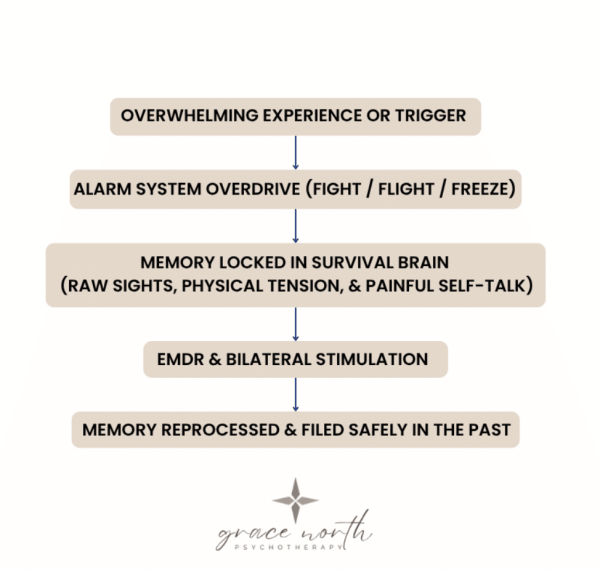
When a memory stays frozen like this, present-day stress acts like an instant replay button. A sharp tone of voice from a partner, a sudden boundary conversation, or feeling dismissed at work can trigger your body to react as if the original event is happening all over again.
During an EMDR session, the side-to-side movements mirror what your brain naturally does during REM (rapid eye movement) sleep—that deep, restorative sleep phase where we process our day. The bilateral taps or eye movements give your brain a dual anchor: one foot remains safely grounded with me in my cozy office, while the other foot gently visits the old memory to finish processing it.
What a Real EMDR Session Looks Like at Grace North
If you’re considering EMDR, it’s completely natural to feel a bit guarded. A lot of women come into our office worried that they’re going to be forced to relive their worst moments or that they’ll lose control.
Our therapists always reassure our clients right away: EMDR is not hypnosis. You are fully awake, totally conscious, and in complete control the entire time. If we need to slow down, pause, or take a break to sip water, we do. We are right beside you as your anchor.
We follow a structured 8-phase framework that puts your safety and comfort first:
- Getting to Know Your Story: We talk through what brought you here, identifying the specific patterns, triggers, or memories you want to heal.
- Building Your Anchor Toolkit: Long before we touch a hard memory, we spend time building up your emotional safety net. I teach you somatic breathing, grounding tools, and visualization techniques so you always feel capable of calming your body.
- Focusing the Target: Together, we gently pick a specific memory to focus on, noticing the image, the negative thought attached to it (like “I am helpless” or “It was my fault”), and where you physically feel that tension in your body.
- The Processing (Desensitization): While focusing briefly on the memory, you follow our therapists’ fingers back and forth or use hand tappers for short sets. After each short set, we take a breath together, and you simply tell us what you noticed—a physical feeling, a new thought, or a shifting memory.
- Anchoring the Truth: Once the distress around the old memory drains away, we pair that memory with a belief that feels true now, like “I survived that, and I am safe today.”
- The Body Check: We do a scan from your head down to your toes to ensure your muscles, chest, and stomach feel completely clear of lingering tightness.
- Closing Down Gently: We end every single session with grounding practices so you leave the therapy room feeling calm, steady, and present.
- Checking In Next Time: At our next session, we check in on how that memory feels and celebrate the space you’ve reclaimed.
How Grace North Psychotherapy Sees EMDR Help With Every Day
While EMDR was originally created to treat severe trauma, clinicians across the world use it for all kinds of emotional pain. In our work at Grace North, we frequently use EMDR to help women navigate:
- Relational Wounds & Childhood Stress: Healing the impact of growing up in unpredictable homes, emotional neglect, or past relationship heartbreaks.
- Maternal Mental Health: Processing scary birth stories, fertility struggles, or intense postpartum anxiety.
- Burnout & People-Pleasing: Releasing the underlying fear of confrontation and the deep-seated belief that you constantly have to earn your worth.
- Panic & Chronic Anxiety: Unwinding unexplained panic attacks, phobias, and social anxiety.
- Single Scares: Car accidents, sudden losses, or unexpected medical crises.
How It Feels on the Other Side
Healing through EMDR doesn’t mean you’ll wake up with total amnesia about your past. What it does mean is that the memory loses its power over your present.
Our clients often describe the transformation as a profound physical shift. The story is still there, but the sharp, hot sting is gone. You can talk about what happened without your heart leaping into your throat or your stomach dropping. Your inner voice shifts from constant self-criticism to a quiet, steady self-compassion: “That was really hard, but I am here now, and I am okay.”
Taking a Gentle Step Forward
If you are exhausted from feeling like past stress or persistent anxiety is running your life, please know that you don’t have to carry it all by yourself.
At Grace North Psychotherapy, our entire team of female therapists is dedicated to creating warm, real, and compassionate spaces where you can exhale and heal at your own pace. We offer both virtual and in-person EMDR sessions across Ontario, including Barrie and Newmarket.
When you’re ready to explore what real relief feels like, we’re here to walk alongside you.